Disclaimer:
The information on this website is for general guidance only and does not constitute financial or investment advice. Always do your own research and seek personalised advice from a qualified financial adviser or mortgage adviser before making financial decisions. All investments carry risk and past performance is not indicative of future results.
Key Takeaways
- Banks assess income, expenses, debt, and repayment buffers together.
- Stable income and clean statements strengthen affordability.
- High living expenses or debt reduce borrowing capacity.
- Buffered interest rates test if you can handle rate rises.
- Improving spending habits can lift your surplus.
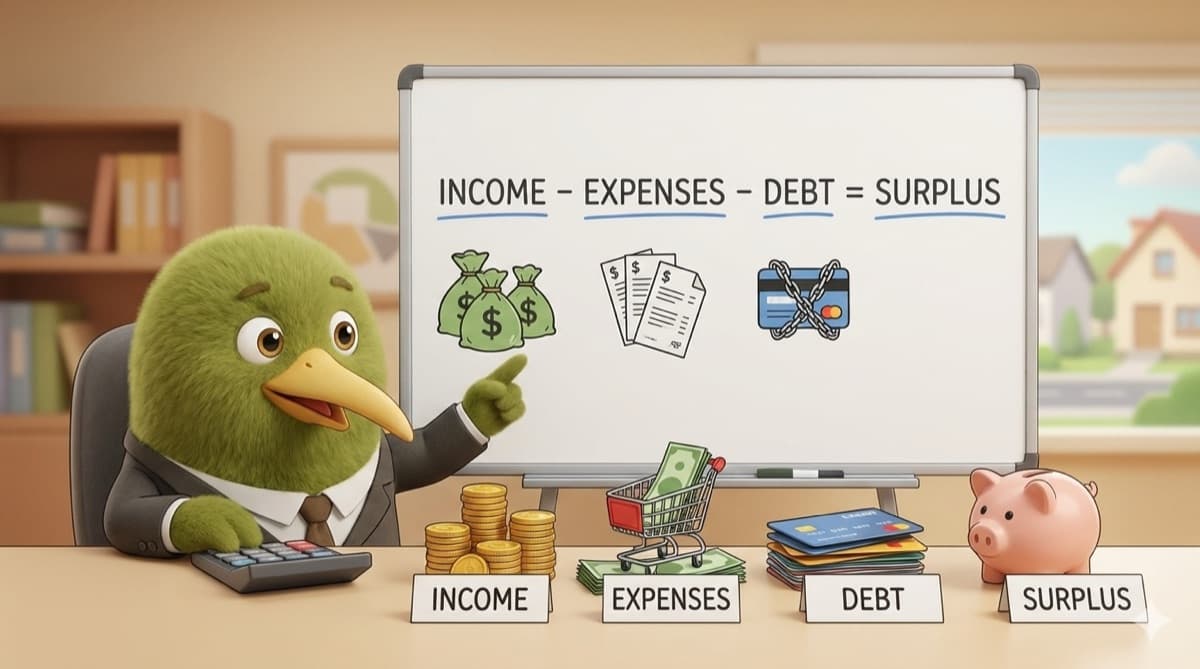
When reviewing a home loan application, banks consider a variety of factors to calculate affordability. However, all factors considered, it can be summarized into this simplified equation:
Income − Expenses − Debt − Proposed Home Loan Repayments = Surplus
So, let's look at these 4 components in more detail to understand what you can do to put your best foot forward when applying for a home loan, and identify any hurdles you may need to overcome.
1. Income
Income is the first factor in determining loan affordability. When assessing a borrower's income, banks typically consider:
- Stability of Income: Lenders prefer borrowers with stable and consistent income sources. They may look at the length of employment or self-employment, as well as the track record of income stability. This helps ensure that the borrower has a reliable source of income to meet their loan obligations.
- Gross Income: Lenders consider a borrower's gross income, which is the total income earned before any deductions. This includes wages, salaries, bonuses, commissions, and other sources of income. Gross income provides an overview of the borrower's earning capacity.
- Other Sources of Income: Besides primary employment income, lenders may also consider other sources of income such as Child Support and Working for Families. These additional income sources can contribute to the borrower's overall affordability.
2. Expenses
Banks consider the borrower's current regular, ongoing, and realistic living expenses. These factors help evaluate the borrower's ability to meet their financial commitments. Common expenses they look at include utilities like power, gas, water, internet, and phone, as well as vehicle running costs covering WOF, registration, and petrol. They also factor in childcare costs, clothing, food and groceries, and medical expenses.
Although you don't need to include rent payments, the affordability calculation does factor in recurring home-ownership expenses such as insurance premiums and council rates. These ongoing costs of owning a home are included because they represent permanent financial obligations once you become a homeowner.
TIP: Focus on reducing your current expenses, and what you can remove.
Need personalised guidance?
Chat with a First Home Buyers Club affiliated mortgage adviser - no obligation!
3. Debt
Debt significantly reduces your affordability for a home loan. Lenders will calculate your Debt-to-Income Ratio (DTI), which compares the borrower's total monthly debt payments to their gross monthly income. It helps determine if the borrower has sufficient income to cover their existing obligations as well as the new loan payment.
Banks also review a borrower's credit history, including credit scores and payment patterns, to assess their creditworthiness. A strong credit history demonstrates responsible borrowing behaviour and may increase affordability.
When banks evaluate your eligibility for a mortgage, they consider all existing debt obligations such as:
- Credit cards/Store cards/Buy Now Pay Later/Overdrafts: Even though you may not currently owe anything on your cards, the affordability calculation will still take into account your ability to make the monthly minimum payment on all of the card limits you have available. As a guide, $10,000 debt can reduce your lending options by $50,000!
- Student Loans: Your monthly student loan repayment is automatically deducted from your income, thus reducing the amount of money you have to service a home loan.
TIP: Ideally, before applying for a home loan you would pay off all debt and close all cards. This would put you in the best position for the affordability calculation. Alternatively, consider reducing your credit card limits. If you have debt owing on cards, ensure you pay the amount owing each month to avoid interest. Note, you may also be able to include a condition on your home loan application that you will reduce the card limit, or pay it off and close the card.
4. Proposed Home Loan Repayments
The final part of the affordability calculation is to confirm you're able to afford the home loan repayments. This is done via a debt servicing test to assess whether your financial situation would stand up to changes in situation during the term of your home loan. This could be increased home loan rates, a change in employment, or something else that could impact your ability to maintain your loan payments.
Important: To calculate your proposed home loan repayments, the debt servicing test uses a calculation of 2% above the current interest rates. This means that you, as a borrower, need to prove that you can afford to borrow at that higher interest rate.
Frequently Asked Questions
Unlock the Mortgage Calculator
Join free to access all our first home buyer tools and calculators.
Create Free AccountAlready have an account? Sign in
Related Articles

A First Home Buyer's Guide to Real Estate Terms and Sale Methods in New Zealand
Essential guide to understanding real estate terms, sale methods, and property jargon for first-home buyers in New Zealand. Learn about auctions, deadline sales, and more.

Buying a Monolithic or Plaster Home in New Zealand: What First Home Buyers Should Know
Essential guide for first-home buyers considering monolithic or plaster homes in New Zealand. Learn about weathertightness, inspections, insurance, and legal protections.

How to Secure a New Build with a 5% Deposit
Learn how first-home buyers can secure a new build in Auckland with just 5% deposit using the First Home Loan scheme and KiwiSaver.

How to Supercharge Your First Home Deposit in New Zealand
Learn proven strategies to accelerate your savings and reach your deposit goal faster with KiwiSaver and smart saving techniques.