Disclaimer:
The information on this website is for general guidance only and does not constitute financial or investment advice. Always do your own research and seek personalised advice from a qualified financial adviser or mortgage adviser before making financial decisions. All investments carry risk and past performance is not indicative of future results.
Key Takeaways
- LVR is the loan amount divided by the property value.
- Higher LVRs mean stricter lending and higher rates.
- Low deposit schemes can help, but have limits.
- RBNZ LVR rules can change over time.
- Equity growth can remove low equity margins later.
If you're preparing to buy your first home in New Zealand, you've likely come across the term "LVR" or Loan-to-Value Ratio. Understanding what LVR means and how it affects your deposit is critical to navigating the home loan approval process successfully.
In this guide, we'll break down what LVR is, how it's calculated, why it matters, and how Reserve Bank restrictions can impact your ability to buy a home.
What is LVR (Loan-to-Value Ratio)?
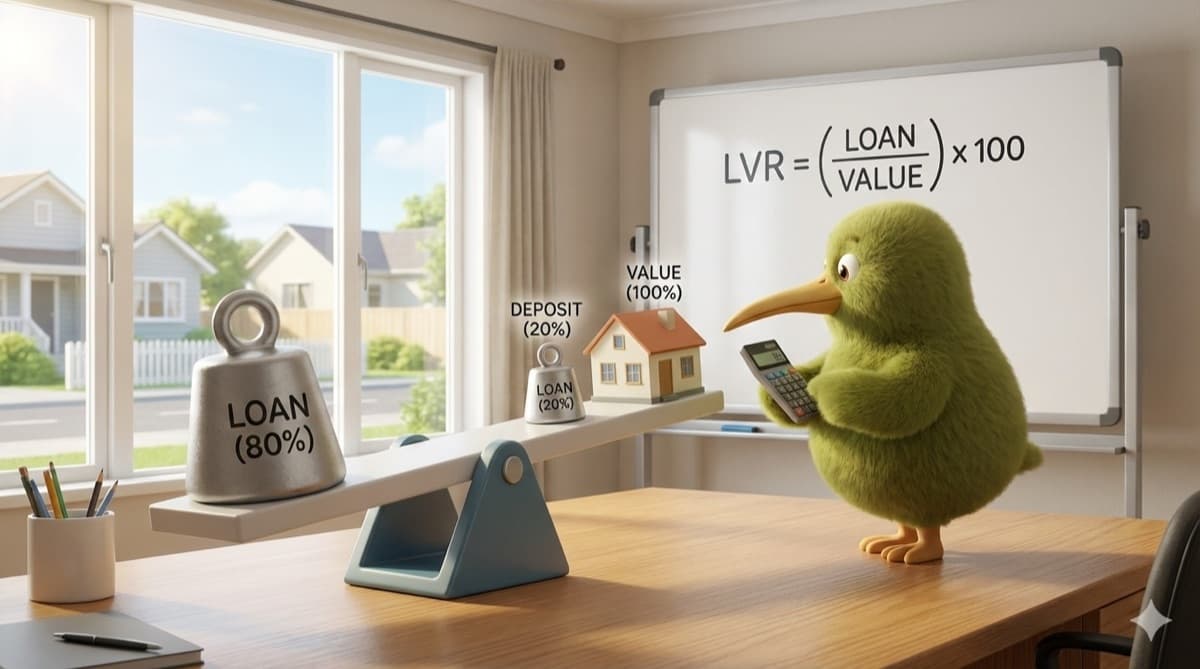
LVR stands for Loan-to-Value Ratio. It represents the size of your mortgage as a percentage of the property's value.
The formula is straightforward:
LVR Formula:
LVR = (Loan Amount ÷ Property Value) × 100
Example:
If you're buying a home valued at $600,000 and have a deposit of $120,000, you'll need to borrow $480,000.
Property Value: $600,000
Deposit: $120,000
Loan Amount: $480,000
LVR: ($480,000 ÷ $600,000) × 100 = 80%
In this scenario, your LVR is 80%, which means you're borrowing 80% of the property's value and contributing 20% as a deposit.
Why Does LVR Matter?
LVR is one of the most important metrics banks use to assess the risk of lending to you. The higher your LVR, the higher the risk for the lender - because if property values fall or you default on the loan, the bank has less equity cushion to recover their money.
For this reason, the Reserve Bank of New Zealand (RBNZ) sets LVR restrictions to help manage financial stability and reduce the risk of housing market bubbles.
Current LVR Restrictions in New Zealand
The RBNZ regularly reviews and adjusts LVR restrictions based on economic conditions. As of recent updates, the key LVR thresholds are:
Owner-Occupiers (Your Own Home):
- Low LVR Lending (over 80%): Banks can lend to a maximum of 20% of their owner-occupier lending at LVRs above 80%
- Practical Impact: Most first home buyers need at least a 20% deposit to avoid being part of this restricted category
Investors:
- Low LVR Lending (over 70%): Banks can lend to a maximum of 5% of their investor lending at LVRs above 70%
- Practical Impact: Investors generally need at least a 30% deposit
Note: LVR restrictions are subject to change. Always check the latest RBNZ guidelines or consult with a mortgage adviser.
What Happens If Your LVR is Above 80%?
If your deposit is less than 20% (meaning your LVR is above 80%), you're considered a high-LVR borrower. This comes with several implications. Banks have restricted lending space for high-LVR loans, so approval is more competitive and you may find some lenders have already exhausted their allocation for that period.
You'll likely pay Low Equity Margins (LEMs), which are additional interest rate charges typically ranging from 0.25% to over 1% depending on your LVR. Banks will also scrutinise your income, expenses, credit history, and employment more closely than they would for borrowers with larger deposits. High-LVR applications may take longer to process due to these additional checks and the limited capacity available.
Learn More: Understanding Low Equity Margins in New Zealand
Need personalised guidance?
Chat with a First Home Buyers Club affiliated mortgage adviser - no obligation!
Have a question about this?
Post it in the First Home Buyers Club forum — get answers from the community and industry professionals.
How to Improve Your LVR Position
1. Save a Bigger Deposit
The most direct way to lower your LVR is to increase your deposit. Even saving an extra 5% can significantly improve your approval chances and reduce additional costs like LEMs.
Learn More: How to Supercharge Your First Home Deposit in New Zealand
2. Use KiwiSaver First Home Withdrawal
Eligible first home buyers can withdraw funds from their KiwiSaver account to boost their deposit, helping to lower their LVR.
3. Consider the First Home Loan Scheme
The Kāinga Ora First Home Loan allows eligible buyers to purchase with as little as a 5% deposit. While this is a high-LVR loan, it's backed by government support and has specific eligibility criteria including income and price caps.
4. Buy a Less Expensive Property
Purchasing a more affordable home means you'll need to borrow less, which can help you stay within the 80% LVR threshold with the deposit you already have.
5. Get Family Assistance
Some first home buyers receive gifts or family guarantees to help increase their deposit. Ensure any family assistance is properly documented and meets bank requirements.
LVR and Property Valuation
It's important to note that banks base your LVR on their registered valuation of the property, not necessarily the purchase price you've agreed to pay.
If the bank's valuation comes in lower than the sale price, your LVR could be higher than you expected - which means you might need to contribute more deposit or renegotiate the sale price.
Example:
Purchase Price: $650,000
Bank Valuation: $620,000
Your Deposit: $130,000 (20% of purchase price)
Loan Amount: $520,000
LVR Based on Bank Valuation: ($520,000 ÷ $620,000) × 100 = 83.87%
In this scenario, even though you thought you had a 20% deposit, the bank's lower valuation means your LVR is actually 83.87% - making you a high-LVR borrower.
Navigating LVR Restrictions with Expert Help
Understanding LVR and how it affects your borrowing capacity can be complex, especially when combined with changing RBNZ restrictions, bank-specific policies, and property valuations.
A mortgage adviser can help you calculate your LVR and assess your borrowing power, giving you a clear picture of where you stand. They can identify which banks currently have capacity for high-LVR lending, as this changes regularly and varies between lenders. An adviser can also structure your application to maximise your approval chances, help you understand the true cost of low equity margins over the life of your loan, and navigate any property valuation challenges that arise during the process.
Learn More: Should I Use a Mortgage Adviser or Go Direct to the Bank?
Take Control of Your LVR Position
Understanding your LVR is the first step to planning a successful home purchase. By knowing where you stand and what options are available to you, you can make informed decisions about how much deposit to save, what price range to shop in, and which lending pathways are right for your situation.
Whether you're aiming for a 20% deposit to avoid LVR restrictions entirely, or you're exploring low-deposit options like the First Home Loan, having a clear understanding of LVR will empower you to navigate the home buying process with confidence.
Frequently Asked Questions
Unlock the LVR Calculator
Join free to access all our first home buyer tools and calculators.
Create Free AccountAlready have an account? Sign in
Related Articles

A First Home Buyer's Guide to Real Estate Terms and Sale Methods in New Zealand
Essential guide to understanding real estate terms, sale methods, and property jargon for first-home buyers in New Zealand. Learn about auctions, deadline sales, and more.

Buying a Monolithic or Plaster Home in New Zealand: What First Home Buyers Should Know
Essential guide for first-home buyers considering monolithic or plaster homes in New Zealand. Learn about weathertightness, inspections, insurance, and legal protections.

How to Secure a New Build with a 5% Deposit
Learn how first-home buyers can secure a new build in Auckland with just 5% deposit using the First Home Loan scheme and KiwiSaver.

How to Supercharge Your First Home Deposit in New Zealand
Learn proven strategies to accelerate your savings and reach your deposit goal faster with KiwiSaver and smart saving techniques.